

The arrival of Kimi K3 tests investors’ faith in Jevons’ Paradox
- Korean memory stock positioning unwinds extended, with US semiconductors also falling.
- Chinese open-weight model Kimi K3 raised fresh questions over AI lab monetisation.
- US CPI inflation negative month over month in June on lower energy prices.
- Hostilities between the US and Iran escalated further.
- Bank of Korea hiked rates for the first time in three years.
- Argentina missed its IMF primary surplus target in H1.
- Brazil’s Lula widened his runoff lead over Flávio Bolsonaro to 8pps.
- Hungary's central bank signalled further summer rate cuts.
Last week performance and comments
Global Macro
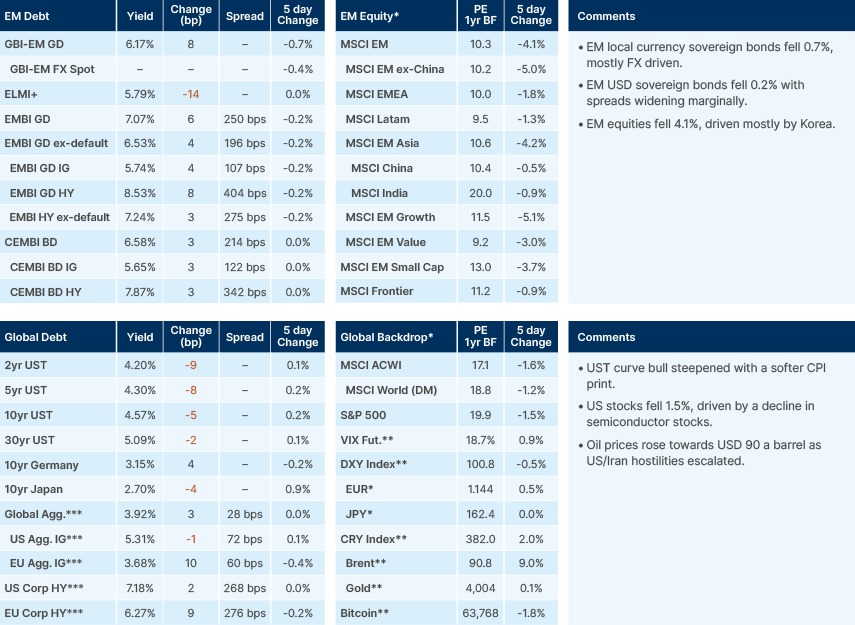
The unwind of Korean memory stocks extended last week, with the US semiconductor complex also continuing its move lower. SK Hynix is now nearly 40% off its June all-time highs, while the Philadelphia Semiconductor Index (SOX) is nearly 20% lower, approaching bear market territory. In our view, the sell-off remains a positioning, momentum and leverage unwind rather than a fundamental one. The Korean retail frenzy, compounded by leveraged ETFs, was always going to produce elevated volatility on the way down, and the Bank of Korea (BOK)’s first rate hike in three years — 25 basis points (bps) to 2.75%, unanimous, with more signalled — accelerated the move by tightening the funding backdrop beneath it.
Leverage and retail hysteria have also played a significant role in US market moves. Notably, however, there has been no unwind in flows yet into US semiconductor stocks. The eight largest semiconductor ETFs took in another USD 2.3bn last week, and tech funds have absorbed a record USD 48bn over the past three weeks. Later in the week, the launch of the Chinese open-weight model Kimi K3 gave the market a new twist to contend with. Moonshot AI’s new models’ performance is close to Anthropic and OpenAI’s frontier models across various metrics, with weights freely downloadable from 27 July. It is the largest open-weight model ever, and the ‘DeepSeek 2.0’ framing sharpened anxieties around AI capex profitability. The frontier labs’ margins and revenue growth have been an important driver of capital raising and sentiment across the sector, so a reassessment of whether the current capex trajectory is sustainable in the face of high quality Chinese open-source alternatives is only natural.
However, we do not think Kimi K3 will meaningfully change the trajectory of the buildout. First, the model is not a cost miracle. On a per-token basis, it prices roughly in line with GPT-5.6, but it is token-inefficient, making it 50-70% more expensive per task. Further, the risk from cheaper, open-weight models is not a reduction in compute demand (Jevons paradox), but a redistribution of margin away from the closed lab towards the infrastructure and application layer. In any case, only around 15% of hyperscaler capex is currently contracted to OpenAI and Anthropic, so the buildout does not hang on their economics. With Alphabet and Tesla reporting Wednesday, among 77 S&P 500 names this week, the market will get an early read on whether AI spending is converting into returns.
The Q2 earnings season so far supports the view that the equity story is broadening beyond tech. Sell-side consensus has S&P earnings growth at 23.6%, a second consecutive quarter above 20%, and 88% of the roughly 50 companies that have reported to date have beaten estimates. Banks led the way last week with results well ahead of expectations, and the momentum in non-tech earnings has the character of an early-cycle recovery: breadth improving, beats concentrated in cyclicals, and global bank stocks surging alongside.
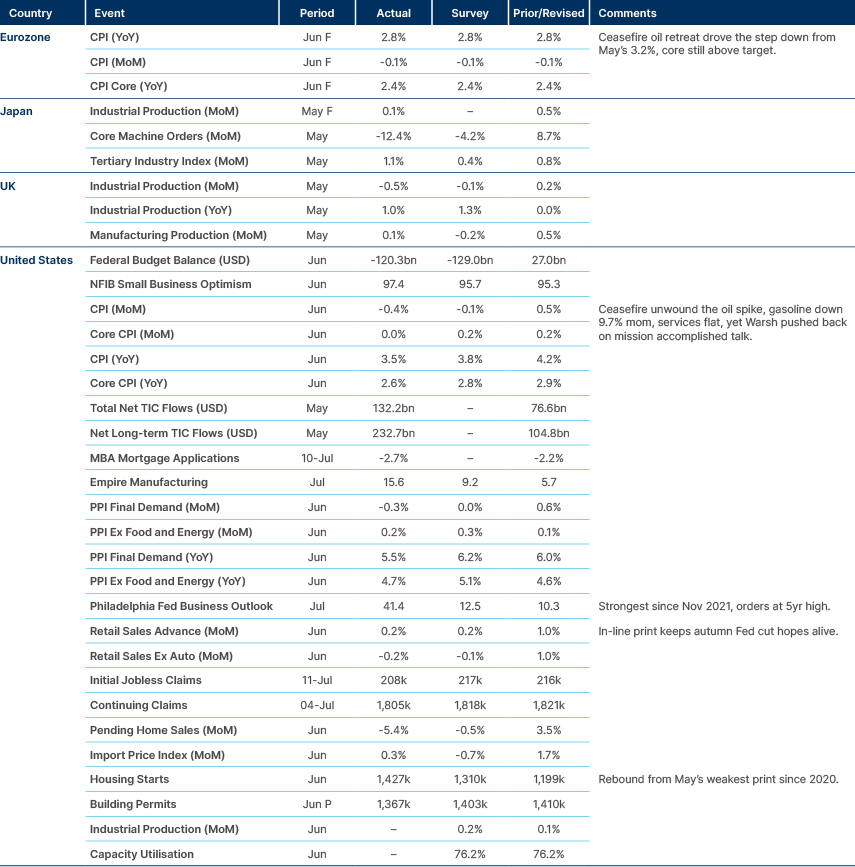
US inflation data was softer last week but is unlikely to stay that way. June consumer price index (CPI) inflation printed negative on the month, with the headline rate falling to 3.5% yoy from 4.2%, driven almost entirely by energy. The 5.7% monthly drop in the energy index was the largest since April 2020, with gasoline down 9.7%, reflecting the brief window in which the ceasefire held and the Strait reopened. The enduring positive is that core inflation remains stable, with services momentum little changed. However, Brent crude is back above USD 85, crack spreads in the US and Europe are at all-time highs, Russian product exports have roughly halved over the past year, and US crude inventories sit at 45-year lows.
The war, meanwhile, escalated through the week. After Iran’s 11–12 July barrage on US assets across six Gulf states, the US ran nine consecutive nights of strikes on Iranian command centres, air defences, coastal facilities and Greater Tunb Island. Iranian strikes killed two US soldiers in Jordan on Friday, Iran hit Kuwaiti oil and water infrastructure twice and struck a Syrian base hosting US forces for the first time, and Tehran declared the June memorandum of understanding suspended.
Despite the re-escalation in hostilities, Iran’s foreign ministry has said that the “diplomatic apparatus” has remained active. We still think renewed de-escalation is the likelier path from here. The key is that, so far, the oil price has been an independent variable in this conflict, not a dependent one – driving the ebb and flow of the war as much as reacting to it. For US President Donald Trump, with diesel and gasoline prices rising and equity markets wobbling, the political cost of further escalation is rising by the week.
Emerging Markets
Asia
The BOK hiked 25bps to 2.75%, its first raise in three years.
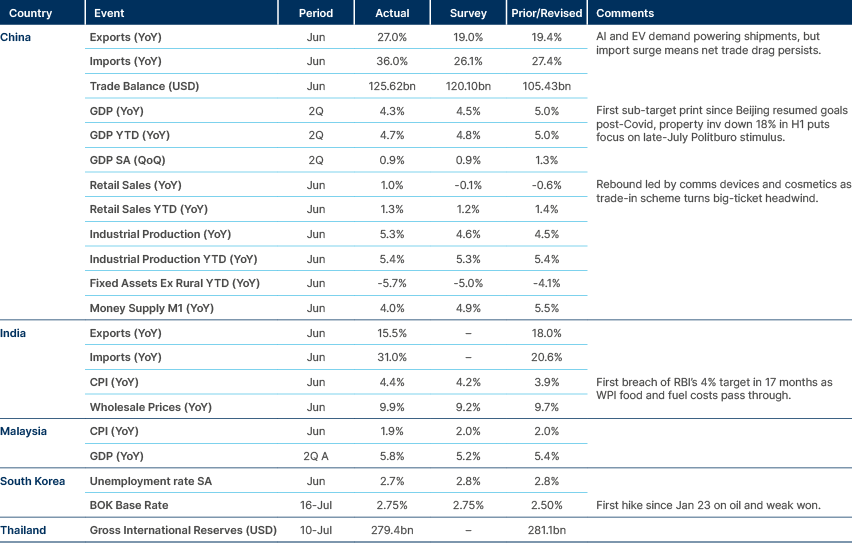
Indonesia: S&P affirmed Indonesia at ‘BBB’ with a stable outlook, making it the only major ratings agency not to have moved to negative after Fitch and Moody’s did so on export-centralisation and fiscal concerns. S&P views the deterioration in fiscal and external metrics as temporary and expects the centralisation of commodity exports to lift revenues over time. It forecasts GDP growth of 5.1% this year, slowing to 4.9% in 2027–28, with the fiscal deficit holding at 2.9% of GDP and the Rupiah appreciating to 17,700 per Dollar by year-end from above 18,000 currently. A downgrade would require net government debt rising by more than 3% of GDP a year or interest costs staying above 15% of revenues.
Malaysia: Prime Minister Anwar Ibrahim said the government will study creating a national petroleum reserve following a National Energy Council meeting, a notable gap given Malaysia produces around 350,000 barrels per day (bpd) against consumption of roughly 700,000 bpd and imported nearly 40% of domestic consumption through the Strait of Hormuz before the crisis. The Economy Ministry meanwhile gave reassurances that fuel supply remains stable and adequate through end-2026 despite the renewed US-Iran exchanges, citing diversified import sources and long-term supply agreements. The government maintained its 4–5% GDP growth forecast for 2026, unchanged since the conflict began.
South Korea: The BOK delivered its first rate hike in three years, raising the base rate 25bps to 2.75% in a unanimous decision and signalling further increases ahead. It now expects 2026 growth to come in well above its May forecast of 2.6%, led by semiconductor exports and investment, while June CPI inflation ran at 3.16% and oil is up over 20% this month on the Iranian re-escalation, keeping inflation expectations elevated. The hike narrows the rate gap with the US Federal Reserve (Fed) to 100bps, which the BOK sees as helpful in restoring the Won’s fundamental value, given its persistent weakness despite surging exports and a widening current account surplus.
The BOK also explicitly rejected suggestions that the semiconductor upcycle has peaked, arguing the market remains in a supply-constrained expansion driven by AI infrastructure demand and high-bandwidth memory (HBM) complexity, with chip exports growing above 160% yoy in April and May, even as the current upcycle outlasts the 29-month average of the previous five. Foreign investors were nonetheless net sellers of Korean securities for a fifth straight month in June at USD 30.7bn, concentrated in equities on concerns over excessive AI infrastructure investment. Against that, SK Hynix’s USD 26.5bn Nasdaq American Depository Receipt (ADR) issuance is set to inject a currency-swap-scale supply of Dollars into the FX market, with most proceeds earmarked for domestic capex and converted into Won, already helping pull the currency from around 1,560 per Dollar back below 1,500. The government separately unveiled a supply-chain resilience strategy classifying critical imports into four categories, expanding stockpiles of items like urea and crude, and targeting a 20% critical mineral recycling rate by 2030.
Latin America
Argentina monthly inflation back below 1.9%.
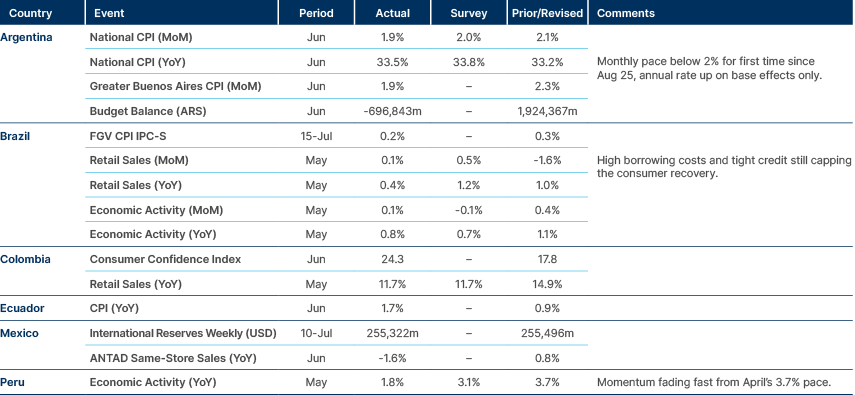
Argentina: The government ran a rare ARS 1.0trn fiscal deficit in June, shrinking the cumulative H1 surplus to just 0.1% of GDP and the primary surplus to 0.6%, and missing the International Monetary Fund (IMF) programme’s quantitative performance criterion of an ARS 6.9trn primary surplus excluding privatisation income (the outturn was ARS 6.3trn). Tax revenues fell 8.8% yoy, with income tax down 20.4% on postponed deadlines but the weakness broad-based, while energy subsidy payments spiked on liquefied natural gas (LNG) imports. The target miss is unlikely to materially affect the IMF’s programme evaluation and fiscal balance (or close to it) is still projected by end-2026, though the June print raises questions on domestic demand and real wages.
Brazil: President Lula widened his runoff lead over Flávio Bolsonaro to 8pps (45% vs 37%) in the July Quaest poll, from 6pps in June, and leads the first round by 12pps. His approval rating crossed into net positive territory at 48% approval versus 47% disapproval. Flávio’s rejection rate rose to 57% and his campaign continues to absorb damage from the Banco Master controversy and his public rift with Michelle Bolsonaro, with whom 42% of respondents sided against 18% for Flávio. The race nonetheless remains competitive, as dissatisfied right-wing voters appear more likely to abstain than switch to Lula, suggesting an electoral ceiling, with the outcome hinging on turnout into the 4 October first round and 25 October runoff.
Central and Eastern Europe
CPI stable in Poland, Romania.
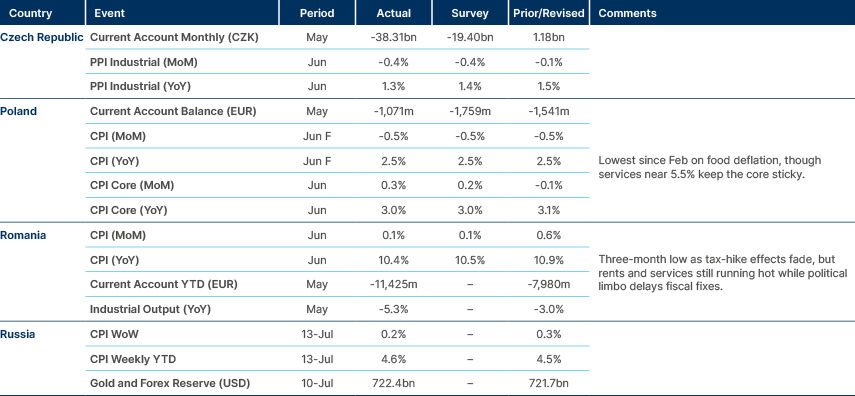
Hungary: Central bank (NBH) Governor Mihály Varga signalled that the improved inflation outlook creates room for further rate cuts during the summer, after June’s cut to 6.0% and a sharp downgrade of the 2026 inflation projection from 3.8% to 1.8%, with 25bps steps in July and August the base case. Separately, the Economy Minister István Kapitány announced that strategic crude reserves have been fully replenished at 87 days of import cover, up from 44 days at end-March following the Druzhba shutdown. Pro-Fidesz thinktank Szazadveg qualified the claim, noting fuel reserves remain below pre-price-cap levels (diesel at 478m litres versus 643m) and gas storage at 53% is the lowest fill ratio in three years, leaving Hungary exposed to global price swings if not to outright shortages.
Kazakhstan: Kazakhstan and China announced commercial agreements worth over USD 15bn during President Kassym-Jomart Tokayev’s visit to Shanghai, spanning AI and digitisation, transport, finance, agriculture and machine building. Highlights include a strategic partnership between the new AI ministry and Huawei, Samruk-Kazyna equipment purchases, EV and vehicle-production agreements with Geely, Li Auto and Chery, and a multifunctional terminal at Kuryk port. Chinese President Xi Jinping said China is ready to share AI technologies supporting Kazakhstan’s digital development, dovetailing with the Data Centre Valley project in Ekibastuz.
Ukraine: Ukraine and nine NATO members, including France, Germany and the UK, established an Integrated Anti-Ballistic Missile Coalition during President Volodymyr Zelenskyy’s visit to Paris. The initiative addresses what is now the dominant threat from Russian ballistic missiles, with Ukraine’s Patriot stocks apparently exhausted and Kyiv seeking European support to accelerate its own Freya anti-missile programme. Progress would also help integrate Ukraine into future European defence architecture without formal NATO membership.
Central Asia, Middle East, and Africa
Inflation flat in Nigeria, Saudi Arabia.

MENA: The Organization of the Petroleum Exporting Countries (OPEC) cut its 2026 global oil demand growth forecast for a third consecutive month to 0.8m bpd, from 1.0m in June and 1.2m in May, while raising 2027 growth to 1.9m bpd, signalling a deferred rebound once disruptions clear. Money managers liquidated the equivalent of 245m barrels across Brent and WTI between late May and end-June, driving the OPEC basket down USD 24.80 mom to an average USD 89.75. The physical market remains tight, with OECD commercial stocks down 21.8m barrels to 2,770m, 48.6m below the five-year average, and forward cover at a lean 59.8 days.
South Africa: Minister Gwede Mantashe proposed replacing the voluntary fuel-storage system with mandatory stockholding, under which the state National Petroleum Company would hold 60 days of net-import cover (70% crude, 30% refined products) and licensed wholesalers and importers a further 21 days at their own cost, with penalties under the National Energy Act for breaches. The policy responds to shipment lead times of 21–42 days to South African ports and a government estimate that a nationwide fuel shortage would cost around ZAR 1bn of GDP per day.
Sub-Saharan Africa: Foreign direct investment (FDI) inflows to Africa fell 25.5% yoy to around USD 70bn in 2025 per UNCTAD, down from a 2024 figure inflated by Egypt’s Ras El-Hekma megaproject, but still the third-highest annual inflow since 1990. The decline contrasts with global FDI rising 6% to USD 1.6trn, driven by developed economies. Egypt led at USD 15bn, Guinea rose more than fivefold to USD 8bn on bauxite and iron ore, Mozambique reached USD 6bn on LNG momentum, while South Africa turned negative at -USD 2.3bn on intracompany flows and profit repatriation. UNCTAD warns of a widening investment divide as global capital concentrates in AI infrastructure, semiconductors, data centres and critical minerals (44% of global greenfield investment in 2025 versus 16% in 2020), with Africa capturing only around 2% of critical-mineral processing investment despite holding at least a fifth of relevant reserves.
Developed Markets
Softer energy prices bring US CPI back to 3.5%.
Benchmark Performance
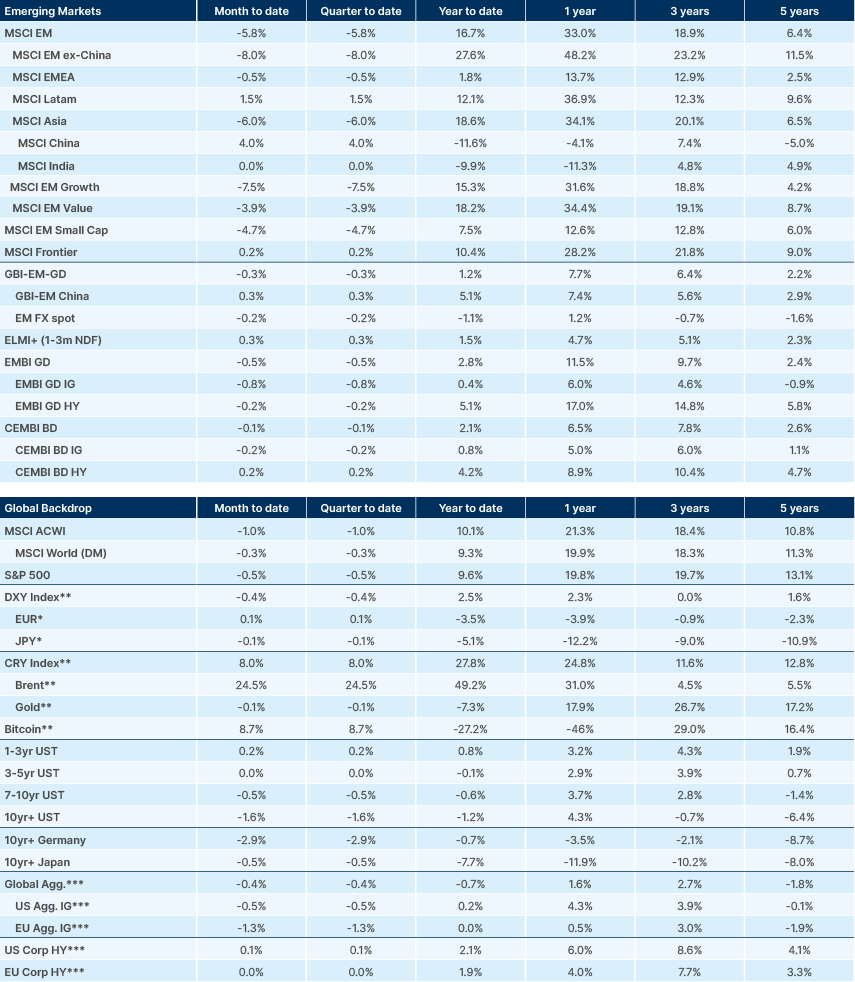
Source and notations for all tables in this document:
Source: Bloomberg, JP Morgan, Barclays, Merrill Lynch, Chicago Board Options Exchange, Thomson Reuters, MSCI. As at latest data available on publication date.
*EMBI GD and EMBI GD HY Yield/Spread ex-default yields and spreads calculated by Ashmore. Defaulted EMBI securities includes: Ethiopia, Ghana, Lebanon, Sri Lanka, and Venezuela. **Price only. Does not include carry. ***Global Indices from Bloomberg. Price to Earnings: 12 months blended-forward.
Index Definitions:
VIX Index = Chicago Board Options Exchange SPX Volatility Index. DXY Index = The Dollar Index. CRY Index = Thomson Reuters/CoreCommodity CRM Commodity Index.
Figures for more than one year are annualised other than in the case of currencies, commodities and the VIX, DXY and CRY which are shown as percentage change.