

The 'Goldilocks' scenario laid out in our 2026 Outlook was postponed by the Strait of Hormuz closure but not derailed by it, in our view. Inflation had a one-off spike, but is coming down, as oil prices have been declining since late-March. While the closure of the Strait lasted longer than expected, our base case remains that both parties are incentivised to keep it open for good.
We see capital expenditure on artificial intelligence (AI), and now energy, defence, and supply chain reorientation, keeping global economic activity well supported. This capex cycle makes a recessionary scenario unlikely.
Second-round inflation effects from the energy price shock are unlikely to become embedded. Consumers have seen their real incomes squeezed by the sharp spike in oil prices, while AI adoption continues to keep a lid on wage growth. At the same time, China continues to export deflation. As a result, the Goldilocks scenario should resume. If we are right, markets may shift from pricing in rate hikes to pricing cuts sooner than many expect. The main risk to rates comes from fiscal largesse and central banks, such as the Bank of Japan (BOJ), remaining behind the curve.
Price action across global markets has been reflecting a benign outcome since the initial ceasefire in April. In our view, the low probability of a recession is the main reason why risk-adjusted returns for emerging market (EM) sovereign debt remain compelling, despite uncertainty around the Strait, private credit, and the AI capex cycle.
In relative terms, improving governance and policymaking across many EM countries, contrasting with the deterioration in governance and policymaking in large developed markets (DMs) such as the US, France, and UK, is making EM assets more attractive relative to DM assets, still, they remain under-owned.
1. The role of EM Debt for asset allocators
Since the birth of the asset class, EM debt has delivered superior risk-adjusted returns over most investable time horizons. One can think of EM sovereign as a marathon runner. It is possible to outperform it in the short term, but very hard to outrun it consistently. Yet this has long been overlooked by asset allocators. In our view, investors remain structurally underexposed to this asset class both from a strategic asset allocation perspective, and cyclically, given the current market environment.
EM debt has delivered higher risk-adjusted returns than DM over the long-term
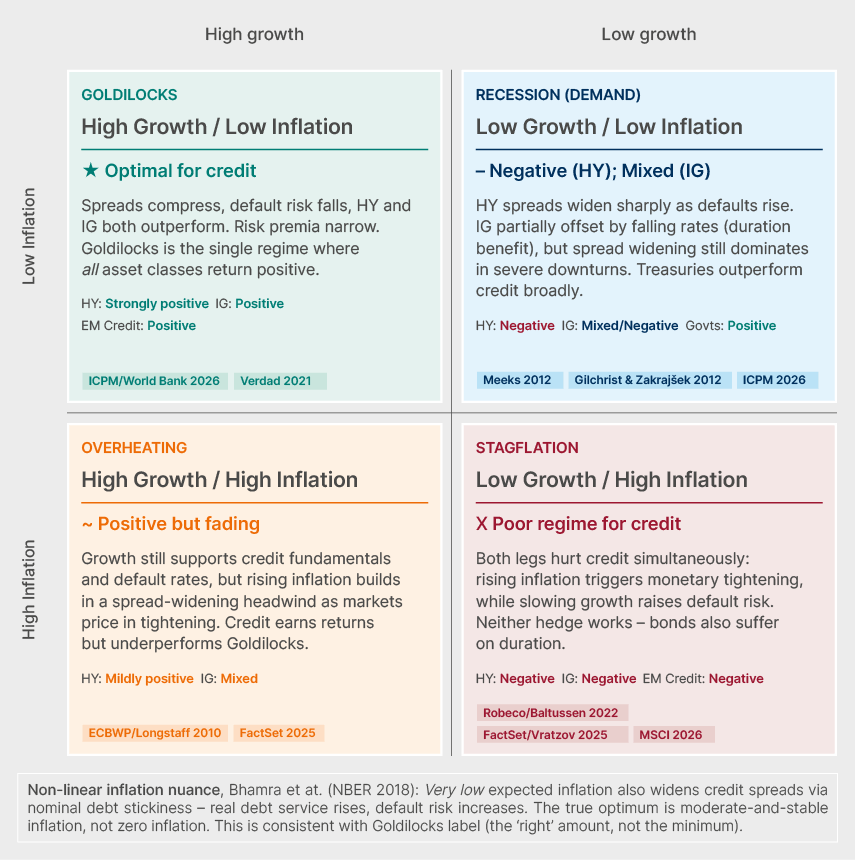
Fundamentally, EM sovereign is a credit asset class. Its risk premium has two main components. The first is rates, typically represented by US rates, which are more relevant for investment grade total returns. The second is the credit risk premium, which is more relevant for high yield. This is cyclical, as credit outperforms in high growth environments and underperforms in recessions. The ideal backdrop is a high growth-low inflation Goldilocks environment. The key risk, as shown in Fig 1,1 is stagflation. Another risk is relative value. This reflects the relative fundamentals, valuations and technicals of EM vs DM sovereign debt, which are discussed in Section 6.
Goldilocks is the optimal macro scenario for EM debt
Fig 1: EM sovereign debt performance across the four macro regimes
2. Key risks for EM Debt
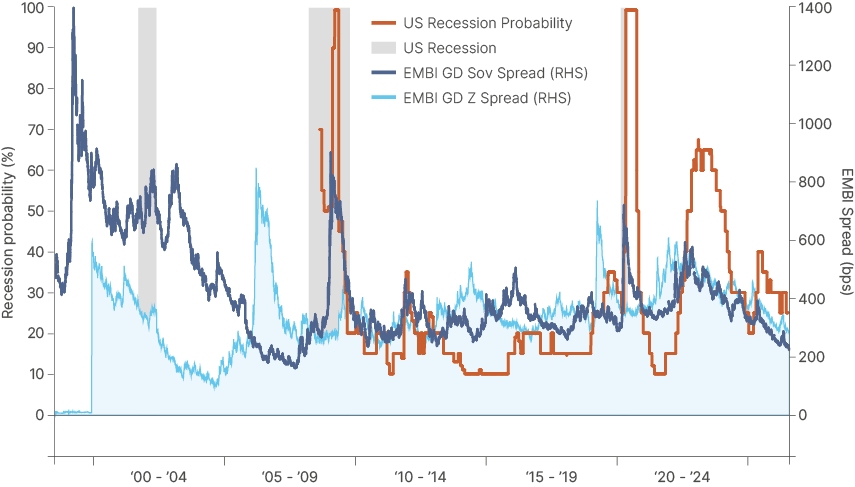
The macro regime analysis in Fig 1 highlights that the main risk for the asset class is not rising core rates. Higher rates are usually driven by growth, which tends to be positive for credit spreads. The main risk is recession, where growth declines, credit freezes, and defaults increase. The most exposed assets in this environment are highly levered companies and countries with few alternatives to roll over their debt. But credit spreads widen across markets regardless, even those with a low likelihood of default. Fig 2 shows how EMBI GD spreads have a large sensitivity to recessions, as well as fear of recessions:
Recession, not higher rates, is the key risk for the asset class
Fig 2: EMBI Spreads (Z-Spread & Sov.) vs US recession probability & US recessions
- Widest spreads on record: 1997-2001 EM balance of payment & debt crisis
- Sharpest upward swings: 2008 GFC & 2020 Covid
- Wider spreads on fear of recessions: 2013 (taper tantrum), 2016 & 2022
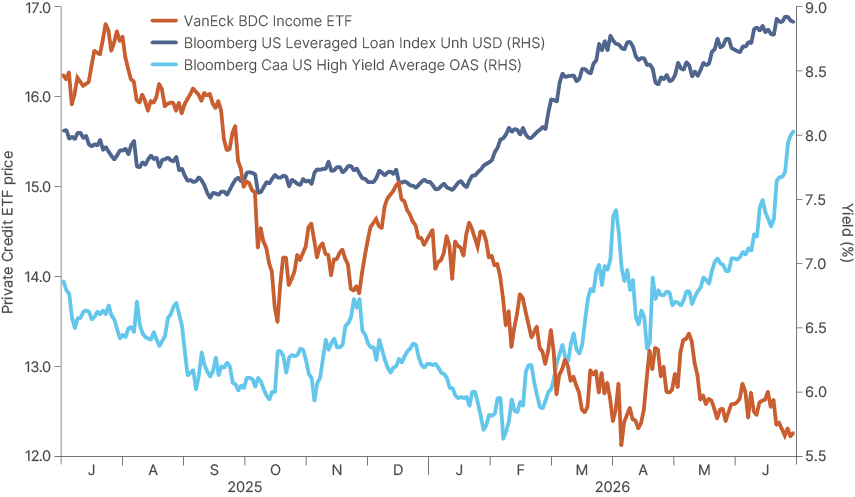
Even if markets were to price in a higher probability of a recession, the assets most exposed today are not in EM sovereign debt, but in DM leveraged loans and private credit, as shown in Fig 3.
US CCC, leveraged loans, and private credit look more vulnerable
Fig 3: Credit spread on CCC; Leveraged loan index; Private Credit ETF
Inflation is less of a risk than a change in the Fed's reaction function:
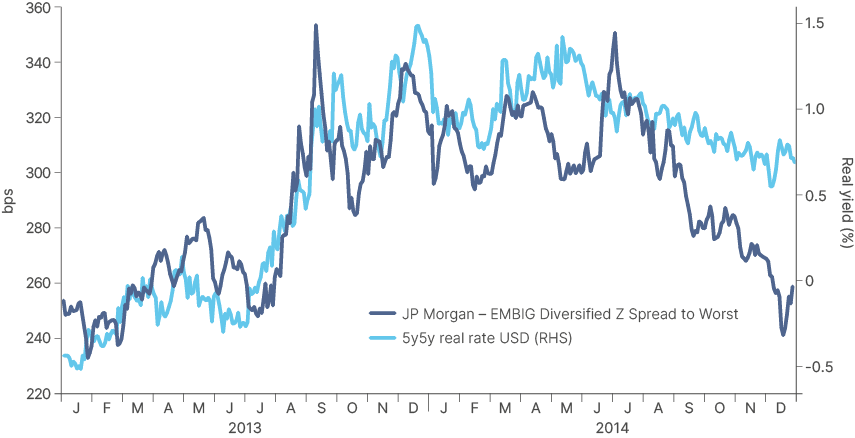
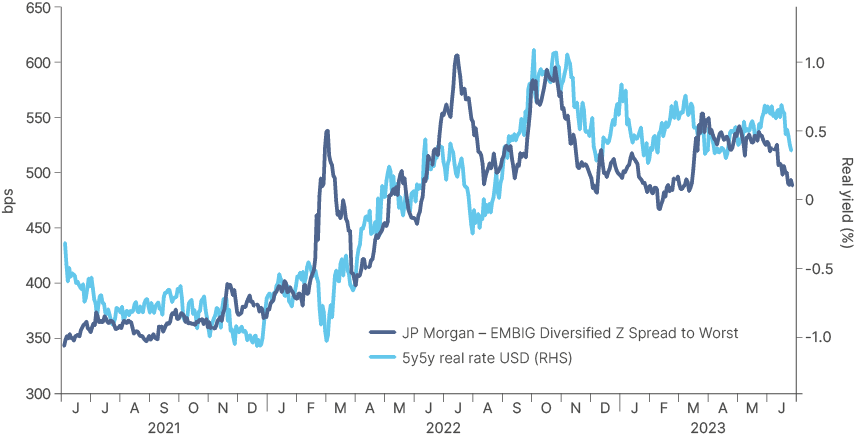
What drives the repricing of risk premia across credit asset classes is not inflation itself, but changes in the reaction function of the Federal Reserve (Fed), and other systemically important central banks. The 2013 'taper tantrum', for example, led to a sharp rise in real interest rates, and therefore in the cost of funding for companies and sovereigns, despite no major inflationary threats, as shown in Fig 4.
Spread repricing is often driven by central bank pivots – not inflation itself
Fig 4: 5y5y real interest rates vs EMBI Z-Spreads during 2013 taper tantrum
The pandemic is another example. Markets were slow to react to the 2021 inflation spike, as investors remained comfortable with the Fed's assessment that inflation would prove transitory, despite ample evidence to the contrary and repeated warnings from EM central banks. The sharp rise in risk premia came only in 2022, when central banks began to respond to inflation, as shown in Fig 5.
In 2013 and 2022, real-rate spikes hurt spreads
Fig 5: 5y5y real interest rates vs EMBI Z-Spreads during 2022 real rates repricing
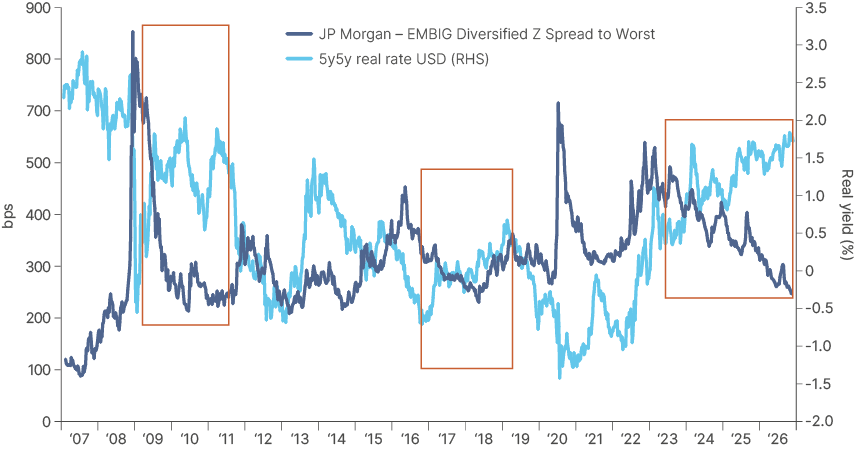
At first glance, the above charts suggest that spreads are positively correlated with real yields, but that would be misleading. Most of the time, higher real rates are a result of stronger economic growth, which inherently lowers the risk of defaults, driving spreads tighter as seen in the 2009-2011; 2016-2019; and 2023-2026 periods depicted in Fig 6. The same figure also shows that spreads widen most sharply during recessions. By contrast, the 5y5y real rates plunge in anticipation of easier policy, as was evident in 2008 and 2020.
…but higher real rates driven by growth drive spreads tighter
Fig 6: 5y5y real interest rates vs EMBI Z-Spreads: Not a linear relationship
A sharp deterioration in EM fundamentals (vs itself and vs DM)
EM fundamentals have been improving, and have further room to improve, in our view, as discussed in Section 5. Nevertheless, if those fundamentals start to deteriorate, EM credit spreads would likely widen relative to other credit asset classes.
3. Global Macro Dynamics
It is very hard to make the case that a recession is on the cards today. We have a high conviction view that we are in the middle of a capex supercycle, driven by investments in AI. The Strait of Hormuz crisis will accelerate investments in defence, energy, and supply chain resilience.
The ongoing investment cycle makes global recession unlikely…
The main risk to the cycle is inflation prompting central banks to raise real rates significantly higher (changed reaction function).
First, the same capex cycle will add cost pressure across the economy. Memory prices have risen roughly sixfold over the past 14 months, while electricity prices in many US states are rising due to higher demand from data centres.
Second, ageing populations are adding demand for healthcare, which in turn is raising demand for labour and putting upward pressure on wages.
Third, the post-pandemic fiscal expansion enabled many businesses to increase margins in the face of supply shocks. They may try to do the same again following the one-off oil price spike.
Fourth, in a multi-polar world, fragmented supply chains are a source of inflationary pressure. However, we do not see a broad de-globalisation trend taking place. That distinction is key. Broad de-globalisation would raise costs across countries. In a multipolar world, countries that do business with China and the US can still benefit from China's disinflationary impulse and access to American capital markets.
On the other hand, US consumer price index (CPI) inflation is likely to have peaked in May and could decline sharply if oil prices stabilise in the USD 70s, as implied by the Oman spot prices, Brent and West Texas Intermediate (WTI). Other factors pointing to disinflation are:
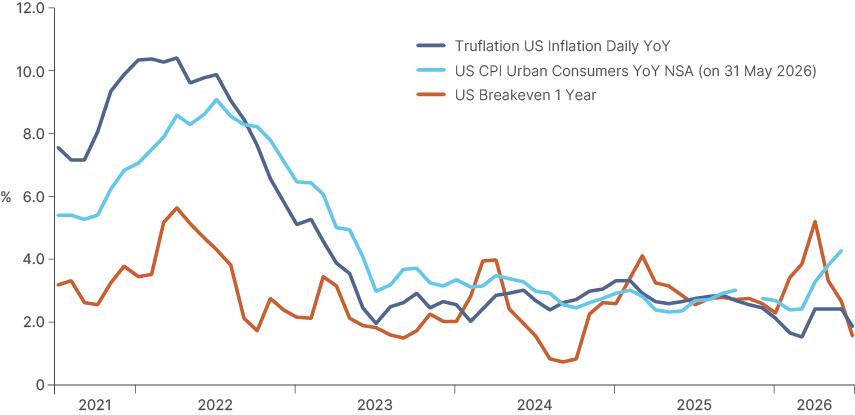
First, inflation expectations remain anchored both in the short and long term. Fig 7 shows that one-year breakeven inflation plunged to 1.55% from a peak of 5.2% in March. Meanwhile, the Truflation index, which tracks prices scraped from the web, never rose above 2.5%.
Implied inflation on 1-year TIPS fell to 1.55% in June on lower oil prices
Fig 7: Expectations anchored: Truflation and market-price of future inflation vs US CPI
…multiple disinflationary forces are still at play, however
Second, the reopening of the Strait should help to normalise energy supply. Demand, meanwhile, has declined rapidly, some of it irreversibly, due to the energy transition. In China, for example, oil demand fell by 1.5 million barrels per day, despite large reserves.
Third, supply is likely to normalise faster than expected. Qatar has signalled that liquefied natural gas (LNG) supply could return to 50% of normal levels within one month and 80% within two months. Kuwait is also reportedly ready to ramp up oil production quickly, having kept its wells operational.
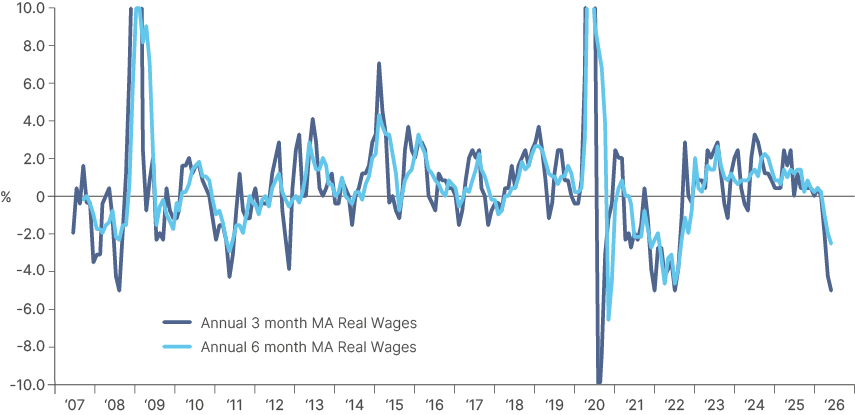
Fourth, there is little evidence, so far, of oil prices pass-through to non-tradable prices as higher energy prices brought real wages to negative levels in the US, as per Fig 8.
Fig 8: Real wages annualised 3- and 6-month moving averages
Fifth, China is still exporting deflation to the rest of the world by increasing production. This remains a structural disinflationary source.
Sixth, US tariffs have fallen sharply following the Supreme Court's February 2026 ruling that IEEPA does not authorise the President to impose tariffs. Trump imposed other tariffs using other mechanisms, but the effect of the legal losses is a materially lower tariff burden than existed in early 2025, with further downward pressure likely.
Last, we still see AI as a disinflationary force for wage inflation. Many sectors and companies, particularly in software, have already been disrupted, forcing them to boost competitiveness. We have seen Chinese large language model companies releasing models that are much cheaper to run, and Jevons paradox suggests lower costs drive higher demand for new technologies – boosting productivity.
Overall, we still believe the Goldilocks environment described in our 2026 Outlook has been only temporarily disrupted by the Strait of Hormuz crisis. The framework for a permanent reopening of the Strait, signed in the Memorandum of Understanding, suggest both Iran and the US need to normalise the situation.
If that holds, although the Fed and the Bank of England have adopted a hawkish tone, they are likely to keep policy rates unchanged. The European Central Bank (ECB) and the BOJ both had lower policy rates and hiked rates by 25 basis points this month. The BOJ should hike again, but the ECB remains data dependent.
4. Six reasons for EM resilience
Improving fundamentals, both in absolute and relative terms to DM, suggest EM debt will trade at structurally tighter valuations, and display lower volatility, than before the pandemic. In our view, EM is converging to DM across economic fundamentals, institutional development and political stability.
Institutional convergence
Political risk is deteriorating in DM, clearly driven by a few large countries such as the UK, France, and the US. On the other hand, there are evident signs of improvement in EM, notably countries such as Hungary, Romania, and much of Latin America (Argentina, Panama, Chile, Peru, Colombia, and Mexico).
"The US has seen the sharpest rise in risk, which is related to growing institutional fragility and a rise in populism. In Europe, France is facing a major and unprecedented political crisis."
Coface Risk Review, October 2025.
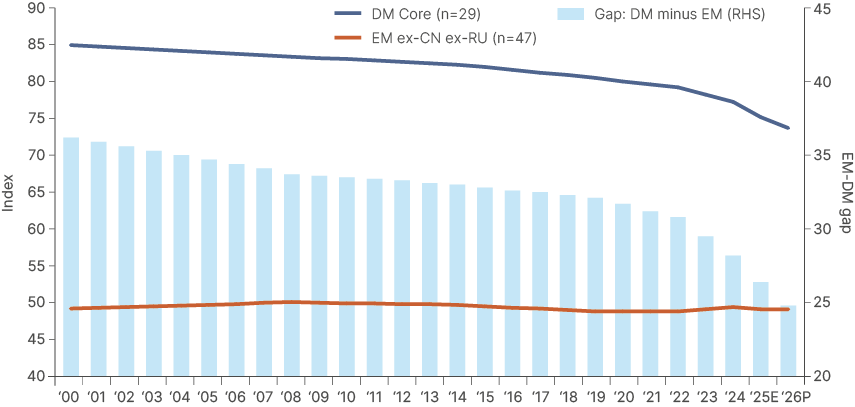
Fig 9 shows a clear convergence between EM and DM in the World Bank Governance Indicator. The data only run to 2024, however, and there is a severe lag between political change on the ground and an effective improvement in the index. The EM stability in the index is explained by a sharp deterioration in Türkiye (-21) and South Africa (-13), and offsetting improvements in the UAE (+12), Romania (+10), Indonesia (+11), Czechia (+4), and Poland (+3). We believe the political transition in Hungary and Latin America as well as the economic reforms in South Africa and Türkiye will lead to an improvement in the index over the next years.
EM institutions are improving as much of DM deteriorates – a re-rating catalyst
DM governance, by contrast, has been clearly deteriorating. The war in Iran and the tariff agenda have exacerbated the sense that the institutional backdrop is deteriorating fast.
Hungary and LatAm political transitions this year will likely bring rating upgrades
Fig 9: GDP-weighted World Bank Governance Index: EM ex-China & Russia vs DM
Inflation targets convergence
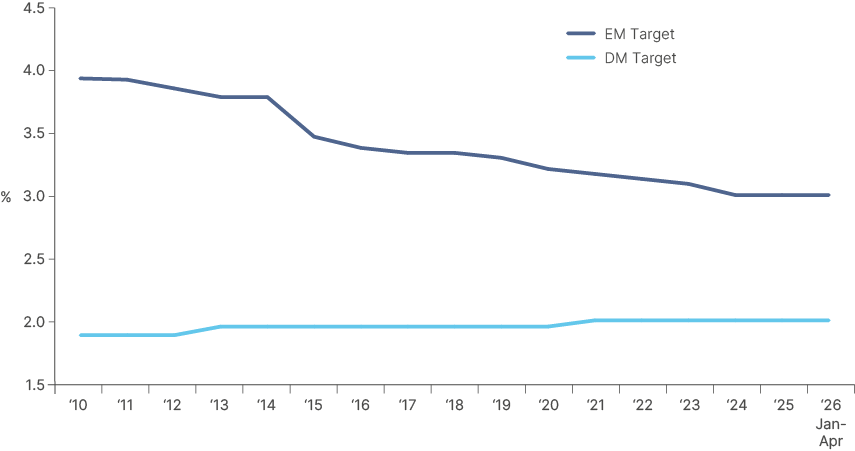
EM central banks continue to strengthen their inflation targeting regimes. Over the last ten years, inflation targets have been lowered in India, Korea, Indonesia, the Philippines, South Africa and Brazil. This can be seen by the convergence of EM inflation targets towards DM in Fig 10. This convergence is likely to have further to run, in our view. The new government in Hungary, for example, has adopted joining the euro as a strategic objective, which would require lowering its inflation target from 3.0% to the ECB's 2.0%.
Inflation targets have been cut in India, Korea, Indonesia, Philippines, South Africa, and Brazil…
…reflecting a structural change in central bank discipline
Fig 10: Inflation targets in EM and DM
DM central banks have softened their focus on inflation
As EM central banks sharpened their focus on lowering inflation, DM central banks have diluted their focus on inflation in favour of other topics, including the energy transition. In 2022, most DM central banks remained well behind the curve, labelling inflation 'transitory' despite ample evidence to the contrary. More strikingly, in 2020, the Fed published its FAIT (Flexible Average Inflation Targeting) framework, under which officials committed to allowing inflation to rise above 2.0% for a period after periods in which it had fallen below 2%, so that inflation would average 2.0% over time. A 2025 Dallas Fed working paper attempted to quantify the cost of that approach, estimating that FAIT raised CPI inflation by around 1.0% and core CPI inflation by 0.5%, with inflation expectations increasing by around 0.8%.2 The Fed eventually abandoned FAIT at Jackson Hole in August 2025.
As DM central bank's mandates have become less laser focused on inflation…
EM central banks acted earlier to rein in inflation
Furthermore, EM central banks placed a much stronger emphasis on bringing inflation back to target in the post-pandemic period. Most EM central banks started hiking policy rates nearly 12 months before their DM peers and kept real rates at elevated levels for longer. This helped to anchor inflation expectations more quickly, and brought inflation down faster, supporting macro stability.
…EM central banks have become more disciplined, eroding the DM credibility premium
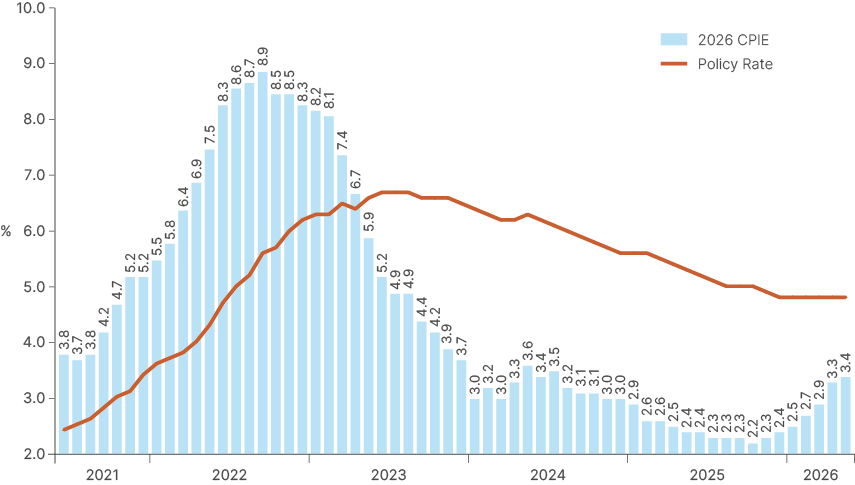
More recently, despite the shock in the Strait of Hormuz being relatively short-lived, several countries have adjusted their policy stance again. Over the last three months, Indonesia, Philippines, South Africa, and Czechia hiked policy rates to anchor inflation expectations, while Brazil and Mexico paused cutting cycles, resulting in still elevated real policy rates. The GBI-weighted EM CPI stands at 3.4%, but the policy rate is closer to 4.9%. In contrast, DM policy rates stand below inflation in most countries. In the US, for example, CPI inflation hit 4.25% in May against a policy rate of 3.75%.
Fig 11: Policy rate vs inflation in EM
Macroeconomic convergence
The growth gap between EM ex-China and DMs has been widening, as EM ex-China GDP has continued to rise year after year, whereas DM growth has stagnated or declined, as shown in Fig 12. Both higher growth and better inflation dynamics favour EM. It also shows how the negative impact on growth expectations from the closure of the Strait of Hormuz in EM is already reversing.
EM ex-China GDP growth continues to widen its gap over stagnant developed economies in 2026.
Fig 12: GDP-weighted GDP growth per region
| Region | GDP Weighted Economic Data / Forecasts | 3m Change | ||||||||||
|---|---|---|---|---|---|---|---|---|---|---|---|---|
| GDP | CPI | GDP | CPI | |||||||||
| ’24 | ’25 | ’26E | ’27E | ’24 | ’25 | ’26E | ’27E | ’26E | ’27E | ’26E | ’27E | |
| EM | 4.3% | 4.4% | 4.1% | 4.0% | 3.8% | 3.3% | 3.2% | 2.9% | 0.2% | 0.2% | 0.0% | -0.1% |
| EM ex-China | 3.6% | 3.8% | 3.9% | 3.7% | 7.0% | 5.2% | 5.0% | 4.2% | 0.2% | 0.2% | 0.0% | -0.1% |
| DM | 1.9% | 1.8% | 1.6% | 1.7% | 2.7% | 2.5% | 2.3% | 2.1% | 0.2% | 0.2% | 0.0% | 0.0% |
| EM vs DM | 2.4% | 2.6% | 2.5% | 2.3% | 1.2% | 0.7% | 0.9% | 0.8% | 0.0% | 0.0% | 0.0% | -0.1% |
| EM x-CN vs DM | 1.7% | 2.1% | 2.2% | 2.0% | 4.4% | 2.7% | 2.6% | 2.1% | 0.3% | 0.2% | 0.0% | 0.0% |
| Latin America | 2.5% | 1.8% | 2.0% | 2.1% | 4.5% | 3.9% | 3.9% | 3.6% | 0.1% | 0.0% | -0.1% | 0.0% |
| Asia | 5.0% | 5.1% | 4.6% | 4.5% | 1.1% | 1.4% | 1.9% | 1.9% | 0.2% | 0.2% | -0.1% | -0.3% |
| Eastern Europe | 2.0% | 2.4% | 2.7% | 2.7% | 4.4% | 3.8% | 3.0% | 2.6% | 0.0% | 0.0% | 0.3% | 0.3% |
| ME/Africa | 2.9% | 3.9% | 4.6% | 3.9% | 20.1% | 13.6% | 10.8% | 8.3% | 0.3% | 0.3% | 0.1% | 0.7% |
Source: Ashmore, Bloomberg. Data as at June 2026. EM ex-Russia & Ukraine.
Credit risk improvement in EM Against Wider deficits and debts in DM
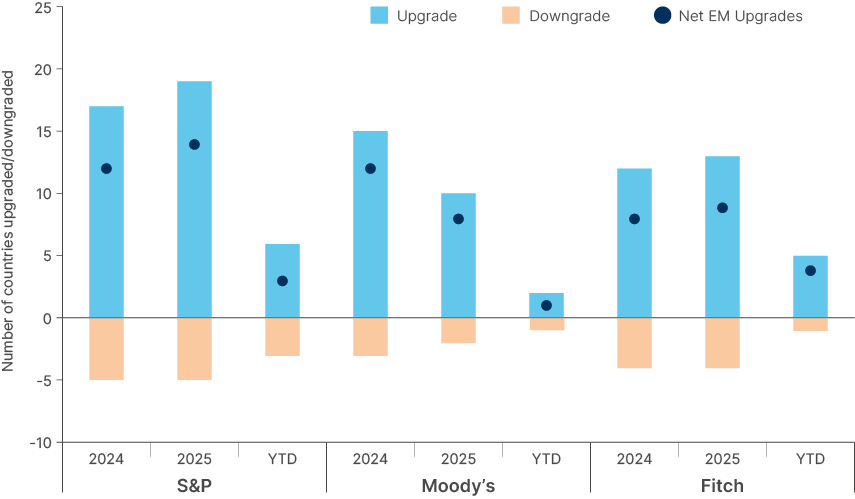
Frontier economies have been undertaking massive structural reforms, resulting in more upgrades than downgrades across EM, as shown in Fig 13.
We saw many more upgrades than downgrades across EM since 2024…
Fig 13: Upgrades/Downgrades by Rating Agency
…with the pipeline still heavily skewed towards future upgrades, in our view
We believe several countries could be upgraded further, including Gabon, Zambia, Argentina, Ecuador, Pakistan, Egypt, Sri Lanka, Ghana, and Nigeria among frontier markets, as well as Hungary, Panama, Morocco, and Oman in EM. Structural reforms in Chile and Colombia after political transitions there could also lead to upgrades.
5. Valuations: The yields are all-right…
The main argument against credit is that credit spreads are tight. This is true. Historical data suggests spreads over US Treasuries are close to their tightest levels on record. However, four factors can help shape investor perspectives when considering valuations.
- Yields remain elevated. Defaults are capped by improving fundamentals
- US Treasuries are a poor proxy for today's funding costs
- EM credit spreads are still wide compared with US credit and equities
- EM equities are undervalued vs US equities
a) Yields remain elevated and defaults are capped by improving fundamentals
EM sovereign debt rivals US high yield on carry with far stronger fundamentals
The EMBI GD yield-to-maturity remains elevated, at close to 7.0%, or c. 6.3% after excluding defaulted securities. The asset class has 48% of its assets comprising investment grade securities and yet offers a very similar yield to US corporate high yield, at close to 7.0% as per Fig 14.
Fig 14: Yield-to-Maturity of selected asset classes
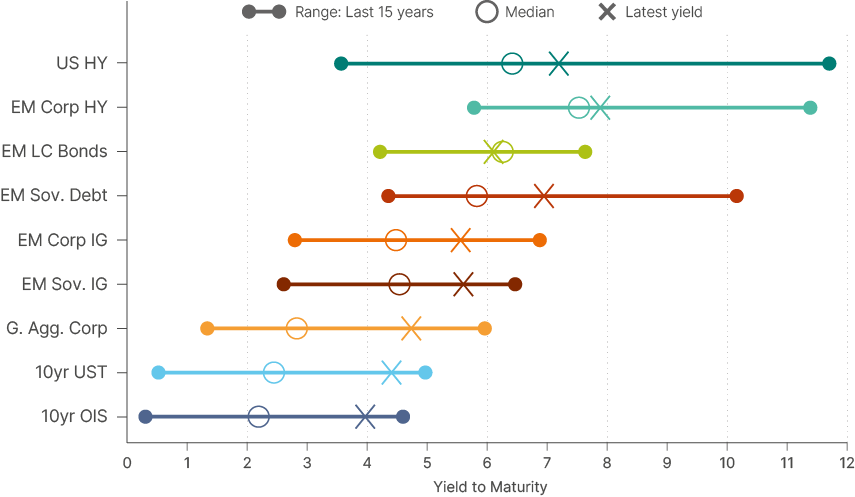
At the same time, default rates dropped to zero over the last three years after the wave of restructurings over 2020-2022. Average default rates tend to be low, at 2.5% over ten years and 1.3% over 20 years, and the post-default recovery rate tends to be much higher than with US high yield, so the loss given default rate is a lot lower.3
b) US Treasuries are a poor proxy for today's funding costs
EM credit is cheaper than it looks…spread vs UST swaps are a cleaner signal than UST
US Treasury yields are trading wide to interbank funding rates due to poor technicals and fiscal concerns in the US. Fig 15 shows that the spread between treasuries and swaps on a portfolio matched to the duration of the EMBI GD is close to its widest level since 2022.
Fig 15: Difference between Treasury yields and swap rates (EMBI GD duration weighted)
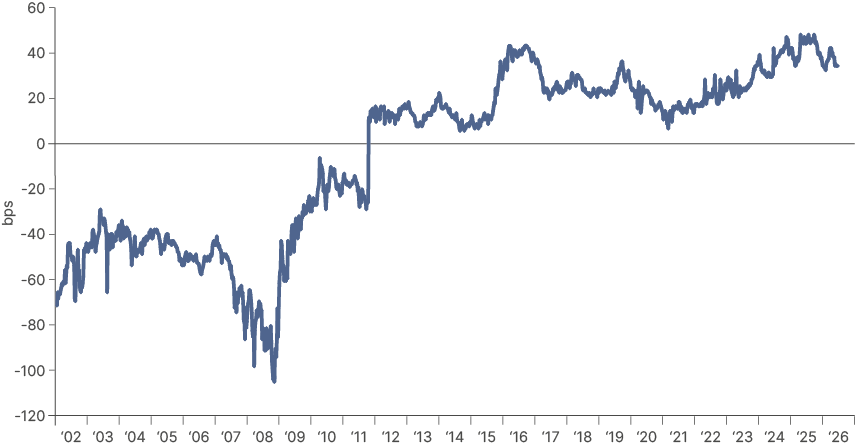
US Treasuries trading 35bps wider than swaps
This artificially compresses credit spreads and explains why some high-quality corporates and sovereigns with good technicals can trade below US Treasuries today.
In EM, China's October 2028 Eurobonds trade 25bps below US Treasuries of the same maturity, close to US swaps. It would not be surprising to see more high-quality issuers, such as Abu Dhabi and Chile, which currently trade around 25bps wide of US Treasuries, to at some point trade below them.
c) EM credit spreads are still wide compared with US credit and equities
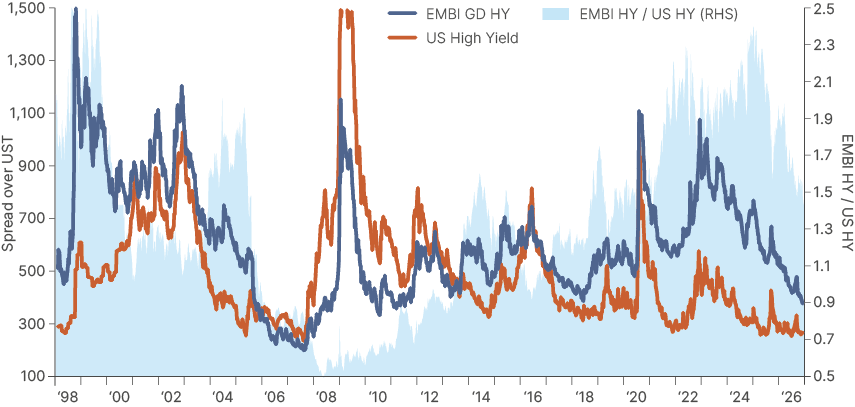
The EMBI HY/US HY spread ratio is above the long-term level…
The ratio of EMBI high yield to US high yield spreads stands at 1.43, above its median of 1.29 since 1998. This ratio peaked in Q4 2024 and since then has been trading lower, as shown in Fig 16. Given the very tight level of US spreads and the improvement in EM fundamentals, a full convergence over the next years looks plausible. EM also traded tight to US high yield between 2005 and 2013. If EM fundamentals continue to improve, this pattern could reemerge.
Fig 16: EMBI HY and US HY spreads over US Treasuries
EM investment grade sovereigns also trade marginally wider than their US counterparts. While it is unlikely that much spread tightening can happen from current levels, elevated yields still make carry attractive in a segment of the asset class where defaults are minimal.
Higher total return opportunities remain in high yield, where EM fundamentals have been improving the most. Of the 50 upgrades since 2024, 16 came from 'C' and 'B' rating levels, 14 in the 'BB' space, and 5 companies upgraded from 'BB' to investment grade. The other 15 countries were ratings upgrade from IG companies.4
On the other hand of the 13 downgrades since 2024, 7 happened within IG (China, Colombia, Mexico, Slovakia, Panama, and Peru), a single downgrade from IG to 'BB' (Panama, who kept IG on other two rating agencies after reforms), three downgrades within 'BB' (Colombia) and two downgrades within the 'B' space (Bahrain).
d) EM equities undervalued vs US equities
The other relative value argument in favour of the asset class is its comparison to US equities, which remain the largest asset class for most global investors.
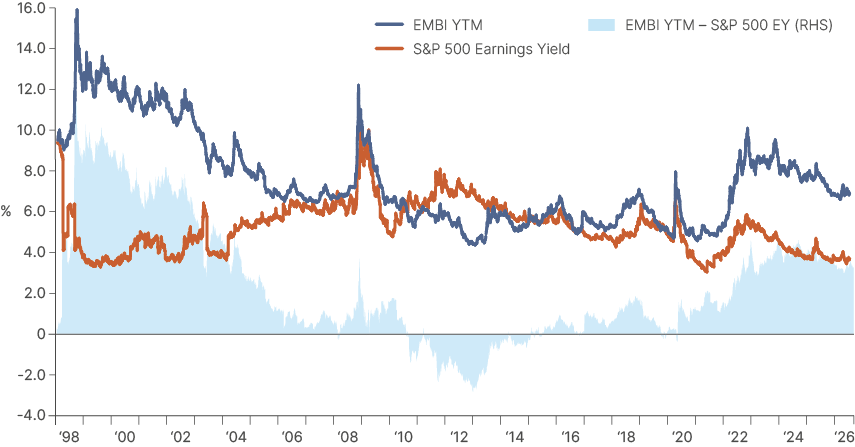
The gap between the EMBI yield-to-maturity and the S&P 500 earnings yield has only been materially wider than today during the 1998-2001 period, when US equity multiples were elevated and EM debt was undergoing a series of major balance of payment crises, including the aftermath of the 1997 Asian financial crisis, the 1998 Russian default, and the 2001 Argentine default.
…while the EMBI vs S&P 500 earnings yield gap near its widest in 25 years at 3.24%
With the EMBI yielding 6.93% and the S&P 500 earnings yield at 3.69%, the gap stands at 3.24%, which is 1.4 standard deviations above the 20-year median of 0.88%. It is also around 0.7 standard deviations above the median since 1997, when the EMBI yield-to-maturity data series began.
Fig 17: EMBI YTM vs S&P 500 earnings yield
Of course, this comparison is imperfect. Equities have a much larger element of uncertainty because they discount a future path of earnings growth. The earnings yield is the inversion of the price-to-earnings (P/E) ratio, and there is little relationship between the P/E ratio and short or even medium-term returns. However, over ten-year horizons, returns have tended to be lower when P/Es are elevated, and vice-versa.
Summary & Conclusion
The macroeconomic backdrop remains supportive for EM sovereigns. The Strait of Hormuz crisis proved to be a temporary disruption rather than a structural break. Inflation has peaked, real wages are recovering, and the conditions for a Goldilocks resumption in late 2026 and early 2027 are falling into place. The capex supercycle, anchored in AI, defence, energy, and supply chain reorientation, continues to support global growth and materially reduces the probability of a recession, which is the single greatest risk to EM credit spreads.
Against this macro backdrop, EM sovereign debt fundamentals are improving in both absolute terms and relative to DM peers. This resulted in more credit upgrades than downgrades, lower inflation targets, stronger central bank credibility, and narrowing fiscal deficits across frontier markets. Governance in several key DM economies has deteriorated markedly, reducing the relative risk premium that EM historically carried.
From a valuations' perspective, credit spreads are admittedly tight by historical standards, but this obscures a more nuanced picture. Yields remain elevated in absolute terms at close to 7%, offering an attractive carry well above what most DM asset classes provide. The spread between Treasuries and swaps exaggerates the tightness of EM credit spreads over US government. Furthermore, the EMBI high yield-to-US high yield spread ratio, at 1.43x – above its long-run median of 1.29x – still offers relative value. Compared with US equities, EM sovereign debt is the most attractively valued it has been relative to the S&P 500 earnings yield since the 1998-2001 crisis era.
The asset class remains structurally under-owned by global allocators relative to its risk-adjusted return history. With a default rate near zero over the past three years, recovering recovery rates post-restructuring, and a wave of frontier upgrades still in progress, the fundamental case for maintaining or increasing EM sovereign debt exposure is compelling. We believe the ultra-marathon runner has not only survived the latest leg of the race – it is on course to set a new pace.
1. See Gilchrist, S. & Zakrajšek, E. (2012). Credit Spreads and Business Cycle Fluctuations; Meeks, R. (2012). Do credit market shocks drive output fluctuations? Evidence from corporate spreads and defaults: Tang, D. & Yan, H. (2010). Market conditions, default risk and credit spreads; Bhamra, H., Dorion, C., Jeanneret, A. & Weber, M. (2018) Low Inflation: High Default Risk and High Equity Valuations; Gilchrist, S., Yankov, V. & Zakrajšek, E. (2009) Credit market shocks and economic fluctuations: Evidence from corporate bond and stock markets.
2. See – https://www.dallasfed.org/research/papers/2025/wp2511
3. 'Quantifying EM sovereign fair value', The Emerging View, February 2020.
4. IG → IG: Aruba, Bulgaria, Croatia, Qatar, Saudi Arabia, Uruguay, India, Kuwait. BB/Ba → IG: Aruba, Oman, Morocco. BB/Ba → BB/Ba: Costa Rica, Seychelles, South Africa, Brazil. B → BB/Ba: Turkey, Costa Rica, Jordan, Mongolia. B → B: Barbados, Egypt, Mongolia, Turkey, Montenegro. C → B: Argentina.